
More efficient clinics through consolidated logistics – the support complex as a strategic building block
When the future of hospitals is discussed, the focus is often on medical innovations, digitalisation or new treatment methods. However, one important factor in the efficiency of hospitals is frequently underestimated: logistics.
Yet it plays a decisive role in determining whether nursing staff and doctors can work efficiently. Due to the growing shortage of skilled workers, there could be a shortfall of up to 690,000 nursing staff by 2049, depending on the calculation scenario. It is therefore essential to make greater use of existing staff resources for patient-centred activities. According to the German Hospital Institute, up to 130 minutes of nursing staff’s daily working hours are spent on non-patient-related tasks such as documentation, logistics or cleaning.
Precisely because organisational structures in hospital operations have evolved over many years, they require thorough review. Logistical functions are located in different parts of the campus, storage areas are spread across several buildings, and goods are delivered to various locations. The temporary storage of materials in corridors or passageways hinders workflows and poses safety risks. Different storage structures, parallel processes and excess stock further increase the complexity. The shortage of skilled staff exacerbates this situation: nursing staff or medical professionals regularly take on logistical tasks, such as procuring materials or handling internal transport. This reduces the time available for medical care. Logistics thus becomes a direct factor influencing the quality of patient care.
To address this challenge comprehensively, the Freyler Group and LOGSOL GmbH are pooling their expertise through a strategic partnership. Together, they are developing integrated solutions that combine logistics planning with construction in the healthcare sector.
A new approach to hospital logistics
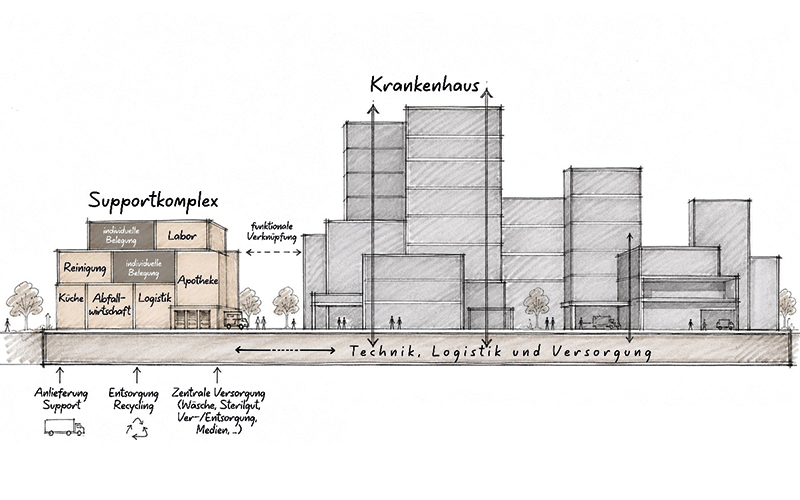
One approach that is becoming increasingly relevant is the support complex. The basic idea is to consolidate medical, infrastructural and logistical functions – the support departments – both spatially and organisationally, thereby making hospital operations more efficient. Instead of numerous individual care units within the hospital, a central location is created where different areas of responsibility are brought together and organised as an integrated system. Material flows can be clearly structured, processes standardised and resources utilised more efficiently. Stock levels can be managed centrally and transport costs reduced.
Niklas Hofmann, an expert in hospital logistics at LOGSOL GmbH, explains: “Modern logistics processes, inspired by best practices in industry, can also be easily implemented in hospital operations. Understanding the need for a holistic view of all supply functions is the key factor for success here.”
At the same time, the consolidation of logistics processes creates the conditions for the cost-effective use of modern technologies. Automated warehouse systems, digital material flow control and autonomous transport solutions can be used most efficiently where sufficiently large volumes of processes are consolidated. Such systems speed up workflows, improve supply reliability, reduce space requirements and lower staffing costs.
Economic and construction-related benefits of a centralised logistics infrastructure
In addition to organisational improvements, there are also significant structural advantages. As many logistical functions do not require a highly specialised medical infrastructure, the support complex can often be constructed as a conventional industrial building. Standardised building structures enable faster planning, a higher degree of prefabrication, and shorter construction times and lower costs. At the same time, technological and energy-efficiency optimisations can be implemented relatively easily.
Holger Hemsing, Managing Director of FREYLER Industriebau, emphasises: “With an industrial building tailored to individual logistical requirements and optimised for energy efficiency, construction and operating costs can be reduced by more than 20 per cent. This is achieved through simplified application procedures, fewer restrictions and a higher degree of prefabrication. When planning and implementation services, steel construction, metalwork and specialists in building services engineering are all provided from a single source, we can minimise interfaces and offer our customers a high degree of certainty regarding costs, deadlines and quality, resulting in seamless and economically viable solutions.”
The support complex as an integral part of the structural transformation of hospitals
The process begins with a potential analysis, in which all relevant material and transport flows are examined. The aim is to gain a comprehensive understanding of the existing structures whilst taking into account the long-term strategic developments of the healthcare facilities. Based on this analysis, a concept study is developed which examines possible variants of a support complex. This involves considering space requirements, warehousing technology, process design, transport concepts and structural framework conditions.
The aim is to achieve an integrated planning approach, in which the optimal processes are first defined and then translated into an overall architectural concept. In addition to functional aspects, construction costs, timeframes, risks and cost-effectiveness are also factored into the assessment. The introduction of a support complex is far more than a mere construction project. It is an organisational transformation in which various departments work together to develop new processes, define responsibilities and challenge existing routines. Medical staff, nursing, technical services, administration and logistics all work towards a common goal.
In this way, the support complex becomes part of a comprehensive transformation strategy. It combines structural, organisational and technological measures to form an integrated, holistic system. When planning, architecture, logistics and operations work together at an early stage, the result is solutions that are both functionally effective and economically viable. For many hospitals, a support complex can therefore become a crucial building block in the modernisation of their infrastructure and in ensuring more efficient healthcare provision in the long term.