
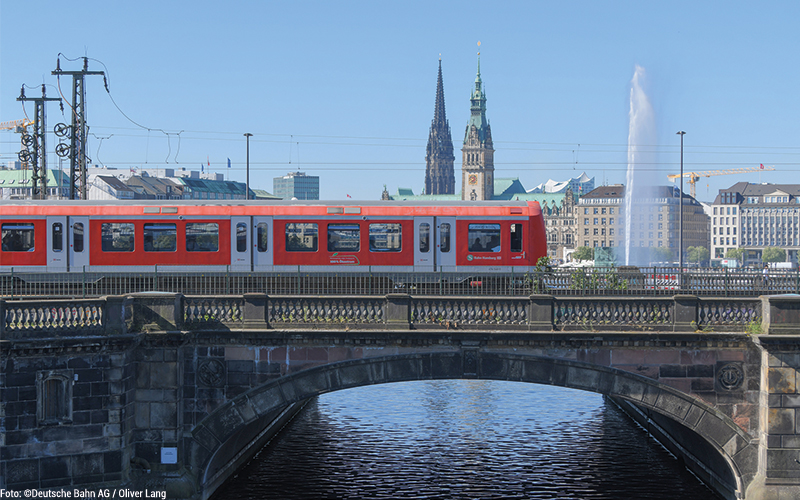
A logistical feat: PeLOGBau is making the Hamburg S-Bahn depot fit for the future
No excavator, crane, or drilling rig can fit through the low tunnel to the S-Bahn Hamburg depot at Elbgaustraße. But behind it, on its premises, a challenging construction project is underway to accommodate the biggest surge in growth in the history of the rail transport company: By 2030, train traffic in the Hanseatic city is expected to increase by around 50 percent. To accommodate the growing fleet of vehicles, the S-Bahn depot needs a new outdoor cleaning facility including a graffiti hall, the construction of a new railcar hall, and the renovation of the office building with energy-efficient modernization using photovoltaics and heat pumps. The construction site can only be reached by crossing the tracks, by rail, or by crane. However, heavy construction machinery and bulky girders/supports still need to be delivered. So how do you set up a construction site in such an isolated location?
Experienced general planner as a quality partner
“This requires very complex and extensive logistical planning,” says Holger Wranna, Overall Project Manager at S-Bahn Hamburg. A cooperative planning and construction process within the framework of Integrated Project Management (IPM) appeared promising. What makes it special is that the owner, planners, and contractors work hand in hand from the very beginning. For tender
package 1, an experienced general planner was needed who could deliver both quality and flexibility. The contract was awarded to the ARGE (consortium) PeLOGBau, which combines the synergies between LOGSOL and the planning office Baumert & Peschos in the best possible way.
“Our services cover everything from architecture and structural planning to railway-specific tasks such as track construction and outdoor facilities,” summarizes Sven Baumert, Managing Director of Baumert & Peschos. Jean-Pascal Heinze, Project Manager at LOGSOL, explains: “We not only contribute logistics planning expertise, but our main focus is on efficient processes in construction logistics. As ARGE, we consider the project throughout its entire life cycle, not just until the completion of the building”. According to him, PeLOGBau also works on a human level – and that makes all the difference.
IPA project involves all partners at an early stage
In the IPA project, all participants first had to “take a generic approach and see what skills were available,” reports Wranna. He considers the resulting type of communication, which involves alliance partners for buildings, traffic and outdoor facilities, as well as railway equipment trades at an early stage, to be a “significant advantage”. Baumert also finds it expedient to cooperate
directly with the construction partner from the outset in order to “check whether our ideas are feasible”. Example from the field of structural engineering: Whether prestressed concrete girders, lightweight wooden girders, or modular steel parts – the decisive factor is what can be best realized and serves the subsequent use. The ARGE has identified sensible logistics and transport
routes in integrated workshops. According to Heinze, the LOGSOL planning tool RoutMan® has been “well received”. A rough construction logistics concept is already available in November 2025. “We structured individual services straight away, such as transport and logistics route planning, material handling and spoil management, or construction phase planning,” says Heinze. The ARGE’s planning scope includes structural civil engineering, building construction, earthworks and underground construction, utility planning and supply, mechanical and electrical engineering, 50 Hz power systems, external works and traffic facilities as well as logistics. Wranna gives a positive interim assessment: “With the ARGE, S-Bahn Hamburg has gained an exclusive partner with skills in plant and factory conversion, experience in planning complex projects, along with know-how in construction and supply logistics. All in all, this will lead our project to success.” Planning will continue in 2026, and the new S-Bahn facility is scheduled for completion at the end of 2028.