
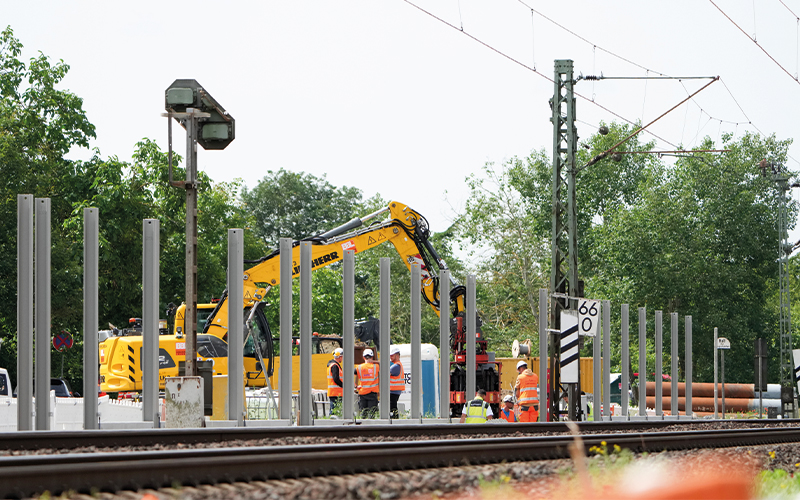
Construction logistics for the comprehensive refurbishment of the Munich–Rosenheim railway line
Better quality, greater punctuality, and significantly fewer infrastructure disruptions: To achieve this, Deutsche Bahn (DB) will be concentrating construction work on its heavily used rail network in the coming years and carrying out maintenance and investment measures as part of general renovations lasting several months.
The corridor between Munich and Rosenheim, together with the route from Rosenheim to Salzburg, forms an important part of the European east-west main line from Paris to Budapest. These routes are heavily used. Whether freight, long-distance, or regional trains – they all have to pass through this bottleneck. If there are delays on these routes, it affects the entire German rail network. For this reason, the two main lines are being renovated and modernized in one go as part of a general renovation. For both lots, the PeLOGBau consortium (ARGE), which LOGSOL forms together with the planning office Baumert & Peschos, has won the construction logistics planning contract for the DB flagship project. LOGSOL’s innovative approach is setting a completely new course: “We think processes through end-to-end by combining experience from construction site projects with our logistics know-how and innovative tools,” emphasizes Mario Henneberger, Head of the Infrastructure Business Unit at LOGSOL.
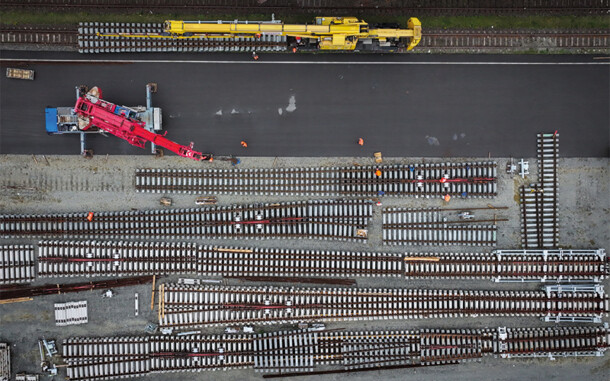
Complex project must succeed without a blueprint
The renovation project encompasses not only tracks, track switches, overhead lines, control and safety technology, but also bridges, noise barriers, and stations. In the “DB General Renovation Construction Logistics” team, seven LOGSOL specialists are determining the requirements for materials, personnel, and machinery, as well as planning track-bound logistics movements, road transport routes, and suitable areas for construction site facilities and material storage.
For the supply and disposal of the construction site, the team of experts must find suitable construction site areas (CSAs) along the route where, in addition to office and personnel containers, materials in particular can be stored, delivered, and transported away. Because the construction sites for both general renovation corridors extend over 140 kilometers, numerous CSAs are required. The logistics planners have to go into the smallest detail, as Henneberger explains: “We evaluate the material requirements and check how many trains or trucks per day are needed to supply the individual construction measures. To do this, we take into account free logistics tracks in the construction process and check, among other things, how wide access roads need to be, for example.”
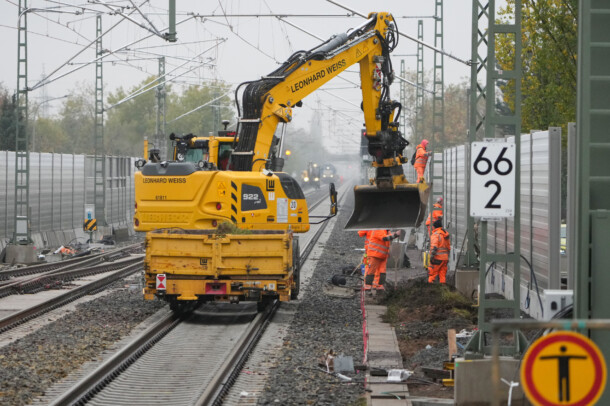
Schedule will be updated iteratively
In the construction schedule, LOGSOL coordinates up to ten participating disciplines, clarifies dependencies, structures the project, and provides an early overview of the individual steps and the respective time frame. “To do this, we bring all sub-projects and specialist planners together to evaluate and take into account all interfaces,” says Henneberger. LOGSOL sets the course so that the construction project can proceed smoothly and efficiently later in the implementation phase. The five-month total closure of the Rosenheim–Salzburg line in the first half of 2027 is driving the team to peak performance. As much as possible must be replaced and renewed during this time – tracks, track switches, overhead lines, noise barriers, electronic signal boxes. In addition, it must be taken into account that businesses with direct rail access must continue to be supplied. LOGSOL checks all parameters through simulations and variant analyses. “If we will determine that the schedule will not work because measures cannot be implemented during the closure period, we will coordinate with the project management and the disciplines to iteratively update the construction schedule and adjust it accordingly,” says Henneberger, explaining the approach.
Having already completed the construction logistics planning for the Rosenheim–Salzburg route, the PeLOGBau team is currently developing a customized solution for the Munich–Rosenheim section.