
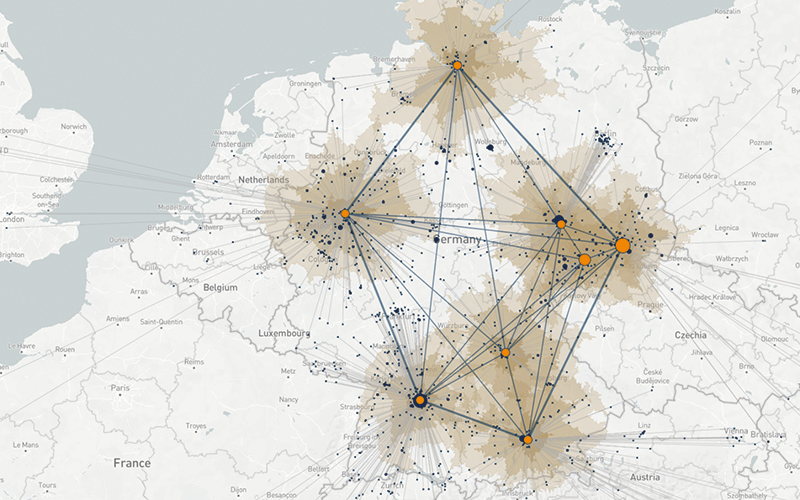
Product distribution and network planning
“A powerful network is not created on the drawing board, but through dialog. We get to know the customer and the business, listen, and identify problems and needs. Together, we develop a viable strategy that balances structures, handling, costs, and transportation – with measurable benefits in daily operations.”
From one location to a powerful logistics network
Growing complexity, cost pressure, and rising service expectations make resilient logistics structures a competitive factor. LOGSOL sees the entire system as a strategic backbone: Structured planning creates transparency, reduces costs, and increases delivery reliability. In this way, the individual locations grow together to form a powerful network – with clear roles and noticeably higher joint effectiveness.
Understanding before designing
The first step is to analyze the current situation: Processes in warehousing and distribution, transport flows, location functions, and product range structures. This is based on valid data on shipments, locations, routes, and warehouse movements. The goal is to achieve a consistent quantity structure and a common understanding of the requirements – prepared in a way that is easy to understand, even for non‑specialists.
Planning with foresight
The design is carried out in stages – from the rough structure to the final architecture. Variants (centralized vs. decentralized storage, hub locations, delivery frequencies, ranges) are evaluated based on logistical and economic criteria. The result is a preferred structure with a clear roadmap for implementation and scaling.
Product distribution as a lever for efficiency
A key factor is the product range logic that suits the locations. Rules are defined based on parts classes or product ranges to harmonize service, handling, and inventory. Fast and slow-moving items, long goods and small parts, as well as location-specific characteristics are taken into account – always with a view to operational feasibility.
Pragmatic despite data gaps
Incomplete master data is not uncommon in projects. Supplementary sources such as inventory records, supplier information, and transaction data are used to derive a robust model. Storage locations and inventory quantities can be used to derive size classes and suitable storage methods – the basis for reliable, practical decisions.
The result: A network that fits the company
The end result is not a standard model, but a solution that is precisely tailored to the needs and goals of the company. A network that works – today and tomorrow. With a well thought-out product range concept, realistic location strategies, and a clear roadmap for implementation.
Practical example
The results of our network projects demonstrate how strategic planning and practical implementation are intertwined. Using the example of sales development in southern Germany, we worked together with a customer to examine the logistical requirements for cost and service-optimized supply. Based on real transport data and service requirements, we developed various scenarios in which factors such as location costs, delivery frequencies, and travel times were systematically evaluated. The result was clear: Setting up an additional hub significantly reduced delivery costs – without compromising delivery times or service quality. This practical example illustrates how data-based planning leads to clear decisions and how analytical transparency can result in concrete competitive advantages.