
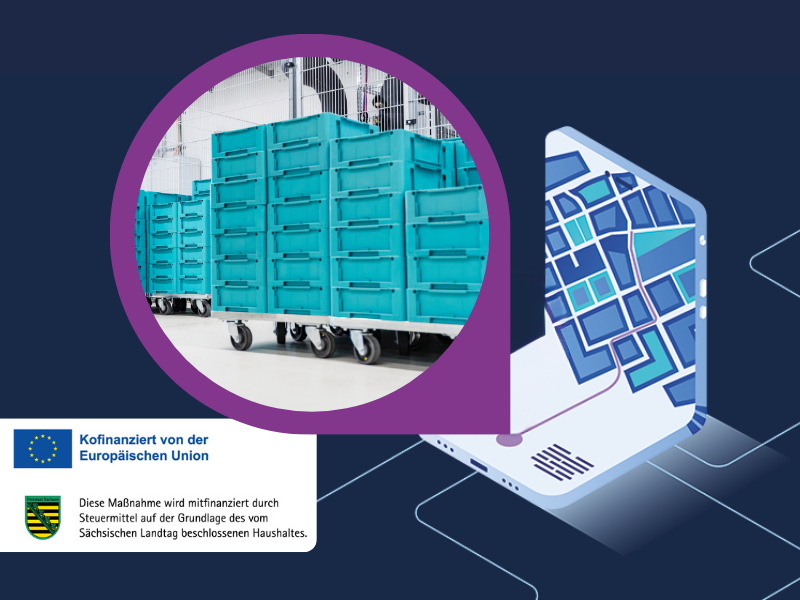
Reusable Container Tracking
How can the inventory of reusable containers be determined reliably and cost-efficiently without equipping each individual container with expensive hardware?
This is precisely the question addressed by the GeoBest research project (“Intelligent geodata-based inventory determination in container management for low-value load carriers”), which is being carried out by LOGSOL GmbH in collaboration with the Technical University of Dresden.
The challenge: Why traditional tracking solutions are reaching their limits
Reusable containers such as pallets or small load carrier boxes are central components of modern supply chains. Especially with closed loop supply chains (CLSC), it is important to have sufficient empty containers available at all times. However, traditional tracking solutions using GPS or RFID are not economical for low-value containers – the costs quickly exceed the actual value of the container. As a result, inventory often has to be posted manually. This is time-consuming, prone to errors, and often leads to bottlenecks or unnecessary transport.
The GeoBest way: Intelligent tracking reimagined
GeoBest follows a hybrid tracking approach:
- A few containers act as “lighthouses” with GPS functionality.
- Many other containers are equipped with inexpensive “buoys” (e.g., BLE beacons) that are automatically detected by the lighthouses.
This creates a flexible sensor network that is supplemented by machine learning methods. Historical movement data and current location signals are combined to forecast actual inventory with high accuracy.
The goal is to have a reliable inventory overview without having to constantly track every single container.
Research focus: From theory to practice
The project is divided into several work steps that systematically build on each other.
- Analysis of typical container cycles – from simple 1:1 relationships to complex peer-to-peer networks.
- Technology selection and simulation – which combination of lighthouses and buoys provides the best coverage with minimal expense?
- Real-world tests with hardware – BLE trackers and beacons are tested under practical conditions.
- Development of ML algorithms – adaptive methods should be able to accurately estimate inventory even on the basis of incomplete data.
- GeoBest software module – the end result is a prototype that can be seamlessly integrated into existing systems such as the LOGSOL BinMan software.
Greater efficiency, lower costs – and a win for sustainability
In addition to cost and efficiency gains, sustainability also plays a key role. Precise demand forecasts enable shipments to be consolidated, empty trips to be avoided, and resources to be used in a more targeted manner. GeoBest can make a notable difference, especially for small and medium-sized companies. Instead of having to make substantial investments in comprehensive tracking hardware, a smart combination of lighthouses and buoys is sufficient.
Outlook: GeoBest on the way to becoming a market-ready solution
Simulations and initial field tests are currently underway. Once the project is complete, GeoBest will be available as a market-ready software module with the goal of creating a new level of transparency and predictability in container logistics.
Together with the Technical University of Dresden, LOGSOL combines practical experience with scientific injection molding research, laying the foundation for trend-setting innovations in container management.